The People Behind the Sound: Meet the Engineers Keeping Hip-Hop's Sonic Legacy Alive

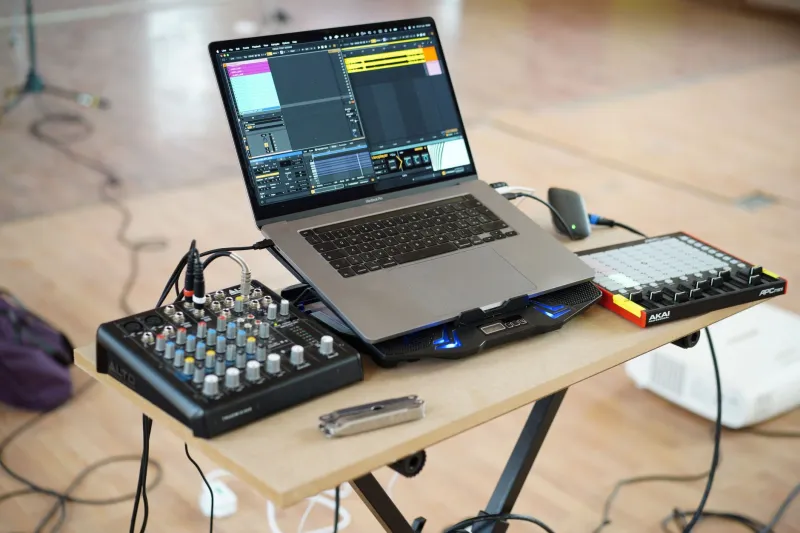
Photo: MIXING PRO, CC0, via Wikimedia Commons
Let me tell you about a job that doesn't exist on most people's radar but quietly determines whether hip-hop's history survives intact into the next generation.
The audio engineer. The studio technician. The person who was in the room when the record was made and who understands, at a molecular level, what that sound actually is — not just what it sounds like through your earbuds, but what it is. The frequency range. The tape saturation. The compression signature. The particular way a specific room responded to a specific voice on a specific night.
These are the people I want to talk about. Not because they've been ignored — they have, mostly — but because the conversation about hip-hop's preservation has gotten loud enough recently that it's time to start centering the people who are actually doing the work.
The Engineer as Translator
Here's something that gets lost when we talk about hip-hop production: the record you hear is not the record that was made. It's a translation. Every step of the process — from the moment sound enters a microphone to the moment it reaches your ears — involves decisions made by human beings with technical expertise and aesthetic judgment.
The engineer is making those decisions constantly. Which microphone captures this particular voice best? How do you preserve the warmth of an analog recording when you're moving it into a digital format? When a track from 1994 needs to be remastered for a streaming platform, how do you honor the original sonic intent without flattening everything that made it distinctive?
These aren't abstract questions. They're the difference between a classic record sounding like itself in 2025 or sounding like a washed-out approximation of itself.
Legacy engineers — the ones who came up working analog boards in studios that no longer exist, who learned their craft in an era when you couldn't undo a mistake with Ctrl+Z — carry a kind of institutional knowledge that is genuinely irreplaceable. They know how certain equipment behaves. They know the specific acoustic properties of rooms that have been demolished or converted into condos. They remember what it felt like to make decisions in real time, with tape running, when getting it right the first time was the only option.
Analog vs. Digital: A Tension That Never Resolved
The analog-to-digital transition in music production is usually framed as a story of progress — better tools, more flexibility, democratized access. And in many ways, that's accurate. The ability for independent artists to produce professional-quality music without a $500-an-hour studio is genuinely significant.
But something got lost in that transition, and the engineers who lived through it are the most qualified people to tell you what it was.
Analog recording has a physicality that digital doesn't fully replicate. Tape has a way of responding to sound that introduces a kind of warmth and compression that's become so foundational to hip-hop's aesthetic that producers have spent decades trying to emulate it digitally. The irony is that the engineers who understand why tape sounds the way it does — not just that it sounds that way, but the actual physics of it — are a finite and aging group.
And the equipment itself is disappearing. Studios that maintained vintage analog gear are closing. Tape machines require maintenance that fewer and fewer technicians know how to perform. When a Studer A800 breaks down in 2025, finding someone who can fix it is a project.
This is not a call for technological nostalgia. Digital production has produced some of the most innovative sounds in hip-hop history. But the sonic DNA of the genre's foundational era is stored on physical media and in the technical knowledge of people who were there — and both of those things are fragile.
The Preservation Problem Nobody's Funding
Here's where it gets uncomfortable. The institutions with the resources to address hip-hop's preservation challenges — major labels, streaming platforms, music industry organizations — have not historically treated this as a priority. Preservation costs money and doesn't generate revenue in any immediate sense. So it tends to fall to individuals.
Engineers who care about the music often do preservation work on their own time, with their own resources. They digitize old tapes. They document session notes. They maintain relationships with artists and estates to ensure that original masters are stored properly. They do this because they understand what's at stake, and because the industry that benefited enormously from their labor is not particularly interested in compensating them for this additional work.
There's a class dimension here worth naming. The engineers who came up in hip-hop — particularly the ones who built careers in Black-owned studios in cities like New York, Atlanta, Los Angeles, and Houston — were often working in environments with less institutional support than their counterparts in rock or pop. The studios they worked in were more vulnerable to economic pressure. The documentation of their work is more scattered. And the cultural institutions that might preserve that history are still catching up.
What Future Artists Are Building From
This matters for the future, not just the past. Every artist who samples a classic record, who studies the production techniques of a foundational era, who tries to understand why a particular snare hit lands the way it does — they're building from material that engineers helped create and preserve.
When that material is degraded, misdocumented, or lost entirely, the chain of influence breaks. Artists end up working from approximations of approximations, removed from the original source in ways that accumulate over time.
The engineers who maintain that chain — who can tell you not just that a particular drum break was recorded at a specific tempo but how it was recorded, in what room, with what equipment, processed through what signal chain — are performing a function that no algorithm can replicate.
They deserve credit. They deserve compensation. And they deserve to be part of the conversation about what hip-hop's preservation actually requires.
Give Them Their Flowers
The culture has gotten better at crediting producers. It's gotten somewhat better at crediting songwriters. It hasn't gotten nearly good enough at crediting the engineers and technicians whose decisions shape the sound of every record we love.
Start there. Ask who engineered the record. Read the liner notes — if they exist. Seek out the interviews where engineers talk about their process, because those conversations are full of knowledge that isn't being transmitted through any formal educational pipeline.
And support the advocacy work being done to establish better standards for audio engineer credit and compensation across the industry. The Recording Academy has made some moves in this direction. It's not enough. It needs to be louder, and it needs to have real teeth.
The sound doesn't preserve itself. People do. Let's start treating those people accordingly.